How to Start a Photography Business: Real Costs, Pricing, and the AI Question
Quick Answer
Starting a photography business costs about $4,300 to $5,700 in year one for a full-frame camera, one zoom lens, software, galleries, and insurance. The median photographer earns $44,660 a year and 67% are self-employed (BLS, May 2025). Pick one niche, price from your yearly costs, register with your state, and book paid work before buying more gear.
TL;DR
- →Year-one cost for a starter kit, software, galleries, and insurance runs about $4,300 to $5,700 at October 2026 list prices
- →Median photographer pay was $44,660 in May 2025, and 67% of photographers are self-employed (BLS)
- →Couples paid an average of $3,000 for a wedding photographer in 2025 (The Knot, 10,474 couples)
- →Insureon's median quotes: $350 a year for general liability, $519 for equipment coverage (April 2024 data)
- →51.4% of new US establishments are still open after five years (BLS Business Employment Dynamics)
On this page +
The camera is the cheap part, even if it doesn’t feel that way at checkout. What decides whether a photography business works is your niche, and whether enough people near you will pay the price you need to charge.
Here are the current numbers for each. I’ve also included what happened when my own store had to choose between hiring photographers and using AI image generators, because that choice is now part of starting out.
How much does it cost to start a photography business?
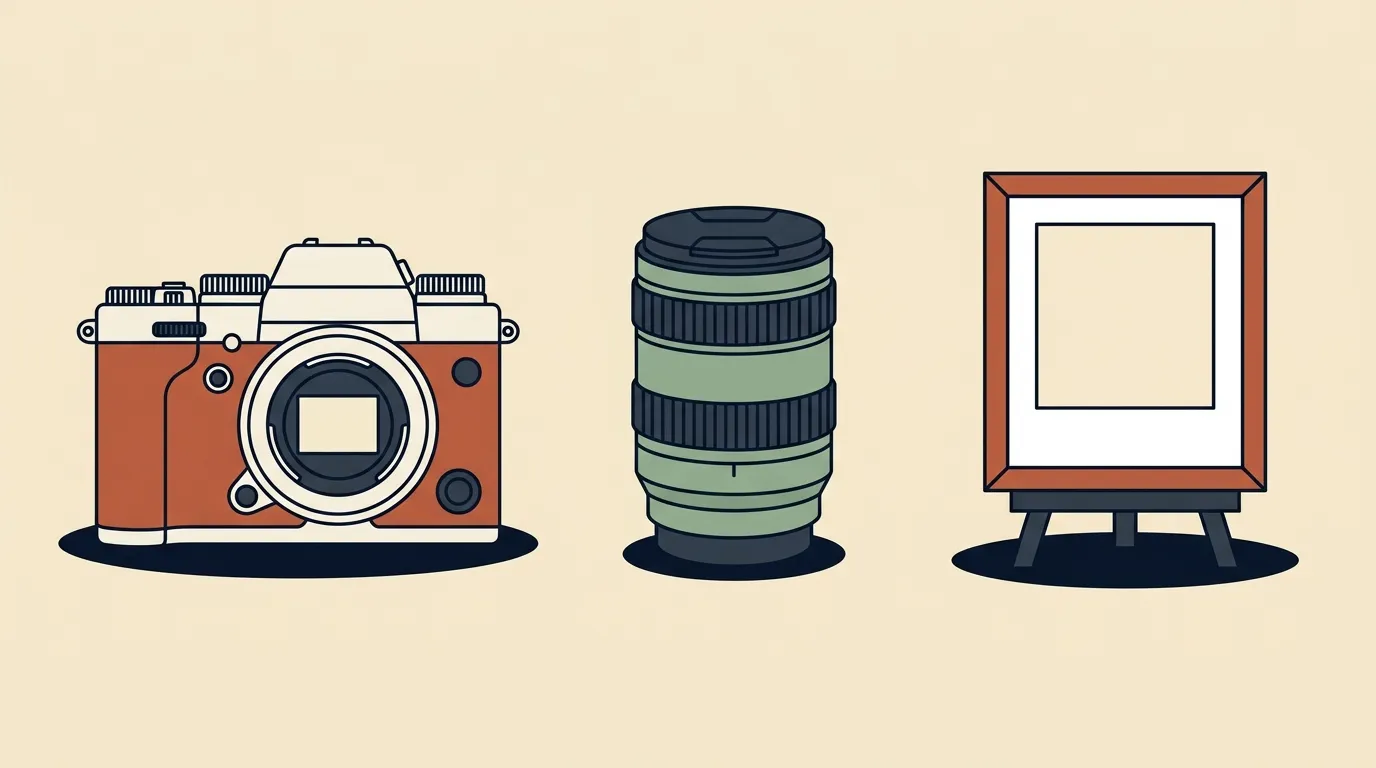
About $4,300 to $5,700 for the first year, before your state’s LLC filing fee. That covers a full-frame camera, one 24-105mm zoom, editing software, client galleries, and insurance.
Here is the math at B&H list prices in October 2026. A Canon EOS R8 body is $1,449 and the RF 24-105mm f/4L lens is $1,399, so the kit comes to $2,848. Step up to the EOS R6 Mark III at $2,799 and the same kit is $4,198. Then add the running costs. Adobe’s Photography plan is $19.99 a month, or $240 a year. Pixieset’s Plus gallery plan is $16 a month billed annually, or $192. Insureon’s median quotes add $550 a year for a business owner’s policy and $519 for equipment coverage.
Two costs are missing on purpose: a second camera body and a studio lease. Wedding and studio shooters will need both eventually. They can wait until paid bookings cover them. You can run your own numbers in the startup cost calculator.
How much do photographers actually make?
The median photographer earned $44,660 in May 2025, or $21.47 an hour, according to the Bureau of Labor Statistics. That figure mixes employees and business owners together. Of the 145,000 working photographers, 67% are self-employed.
For an owner, that median is a warning more than a target. Half the field earns less, after a full year of shooting, editing, answering email, and chasing invoices. An employee takes that pay home. You don’t, because yours also has to cover the insurance, software, and gear replacement from the section above.
The outlook is flat. BLS projects photographer jobs to fall 1% between 2025 and 2035, with about 10,700 openings a year, mostly from people leaving the field. In practice, your growth comes from winning clients other photographers already have. Your niche and your price will matter far more than your camera body. Most new photographers get that order backwards.
Which photography niche makes the most money?
Weddings pay the most per booking. Couples married in 2025 paid an average of $3,000 for their photographer, according to The Knot’s Real Weddings Study of 10,474 US couples. The median sat at $2,800, with the lower quartile at $1,500 and the upper at $4,700.
That money comes with conditions. Wedding work is seasonal and mostly on weekends. A missed moment can’t be reshot. That’s why serious wedding shooters carry a backup body, and it pushes your startup cost to the top of the range.
Portraits, headshots, and product photography pay less per job, but the clients come back. A shop that needs new product images every season, or a company refreshing staff headshots each year, books you again without a new sales pitch.
My advice is to pick one niche and stay in it for the first year. A portfolio that shows one kind of work, done well, sells better than a sampler of everything.
How should you price a photography session?
Price from every hour the job takes. The Knot’s $3,000 average works out to about $375 an hour across an 8-hour wedding day. But the shoot is only part of the job. Culling, editing, delivering the gallery, and the planning calls before the day all add hours the client never sees.
So start from what you need to earn in a year. Add your fixed costs. For the starter kit above, software and insurance alone run about $1,500 a year. Then divide by the number of sessions you can realistically book. The answer is your floor price per session, and you shouldn’t quote below it.
If that floor lands above what your local market pays, you have two real choices. Cut your costs, or move to a niche with higher prices. Booking more cheap sessions is what most people try first, and it usually burns them out. The break-even calculator will run this math with your own figures. The residential cleaning business plan shows the same math.
Do you need a business license to be a photographer?
Usually yes, though the rules depend on your state and city. Most photographers need a general business license from their city or county. Many states also require a seller’s permit if you sell prints, albums, or other physical products, since those are often taxable even where the session fee is not.
Two more steps cost little. An LLC keeps business debts separate from your personal assets, and filing fees vary by state. An Employer Identification Number from the IRS is free and takes a few minutes online. It also keeps your Social Security number off client invoices and the W-9 forms commercial clients will ask you to fill out.
None of this is legal or tax advice. Whether a session fee is taxable changes a lot from one state to the next, and so do licensing rules. A short call with your state revenue department, or an hour with a local accountant, is worth it before you send your first invoice.
What insurance does a photography business need?
Start with general liability and equipment coverage. Insureon’s median quotes for freelance photographers and videographers are $29 a month ($350 a year) for general liability and $43 a month ($519 a year) for equipment coverage. Those figures are from April 2024, so expect today’s quotes to run somewhat higher.
General liability covers the guest who trips over your light stand at a reception. Venues often ask for proof of it before they let a vendor in. Equipment coverage, also called inland marine, protects your gear in transit and on location. A homeowner’s or renter’s policy often excludes gear used for business.
Professional liability is the third policy to consider. At a median of $34 a month ($405 a year), it covers claims that your work failed the client, such as a corrupted memory card that loses half a wedding. For one-off events, it’s worth it. A business owner’s policy bundles general liability with property coverage for about $46 a month.
Will AI image generators replace photographers?
For some jobs, AI already competes on price. Midjourney’s plans run from $10 to $120 a month. For a store that needs dozens of product images a season, that’s far cheaper than a shoot.
We felt it at Craftan, the handicrafts store I run. We had a real debate about whether to keep hiring photographers or switch to AI image generators. The generators have gotten very good, and they cost a fortune less. What I found is that no AI tool matched the thinking a human photographer brings to the job. The way a good photographer composes a shot and arranges the pieces in the frame is on another level. In the end we used a blend of human and AI photography.
For anyone starting out now, plain, repeatable images, like a product on a white background, are the easiest jobs to hand to AI. Deciding how the pieces should sit in the frame is harder to hand off. Build your pricing around that skill.
What are the odds a photography business lasts five years?
Roughly even. Of the US establishments that opened in the year ending March 2020, 80.9% were still open a year later and 51.4% were still operating in March 2025, according to BLS Business Employment Dynamics data. That covers all industries, so treat it as a baseline for photography.
Photography has two traits that help. Startup costs are low next to a food truck or a storefront, and your main asset can be resold if you stop. A camera body bought for $1,449 doesn’t lose all its value the day you close.
It also has one trait that hurts. With two thirds of photographers self-employed, most of your competitors are one-person shops that can drop their prices whenever they need cash. You won’t win that fight on price.
So do the dull things early. Write a price list. Get a signed contract for every booking, keep a separate business bank account, and check monthly what each session actually cost to deliver.
FAQ
Frequently Asked Questions
Can you start a photography business with no experience?+
How much should a beginner photographer charge?+
Is a photography business profitable?+
Do I need an LLC to start a photography business?+
What camera should I buy to start a photography business?+
Sources
- Photographers, Occupational Outlook Handbook, U.S. Bureau of Labor Statistics (pay data May 2025, projections 2025 to 2035)
- Establishment survival, Business Employment Dynamics, Table 7, U.S. Bureau of Labor Statistics (cohort opened in year ending March 2020)
- Average cost of a wedding photographer, The Knot Real Weddings Study (2025 weddings, 10,474 couples)
- Photographer insurance cost, Insureon (median quotes, April 2024)
- Canon EOS R8 body, B&H Photo (list price, October 2026)
- Canon EOS R6 Mark III body, B&H Photo (list price, October 2026)
- Canon RF 24-105mm f/4L IS USM, B&H Photo (list price, October 2026)
- Compare photography plans, Adobe (US pricing, October 2026)
- Client Gallery pricing, Pixieset (October 2026)
- Comparing Midjourney plans, Midjourney (October 2026)
- Get an Employer Identification Number, Internal Revenue Service
Asim
Founder, Business Tips Plus · Co-founder, Devsort
Asim is a technology entrepreneur and co-founder of Devsort, an AI/ML services company. He writes about starting and running small businesses because he's done it: the tools, mistakes, and decisions that actually move the needle.
Connect on LinkedIn →